
Can You Sue an Aurora Contractor for Not Pulling Basement Permits? A Step-by-Step Guide
Can you sue an Aurora contractor who finished your basement without pulling permits? In most cases, yes. A contractor who skips required basement remodeling permits in Aurora, CO has usually breached your contract, and Colorado law gives homeowners several ways to recover the cost of fixing unpermitted work. But a lawsuit is the last step, not the first. This guide walks you through the whole process in order: confirming what should have been permitted, documenting the problem, pursuing the contractor, and getting the work legalized so it does not wreck your resale value later. When you need to sue a contractor over an unpermitted basement, knowing your legal options and the steps to take—from documenting the problem through legalizing the work—protects your investment and resale value.
This matters most if you are planning to sell in the next one to three years. An unpermitted basement finish can stall a closing, scare off buyers, or force a price cut. If you are still in the planning stage and just want to avoid this mess entirely, the steps below also double as a checklist for vetting the next contractor you hire.
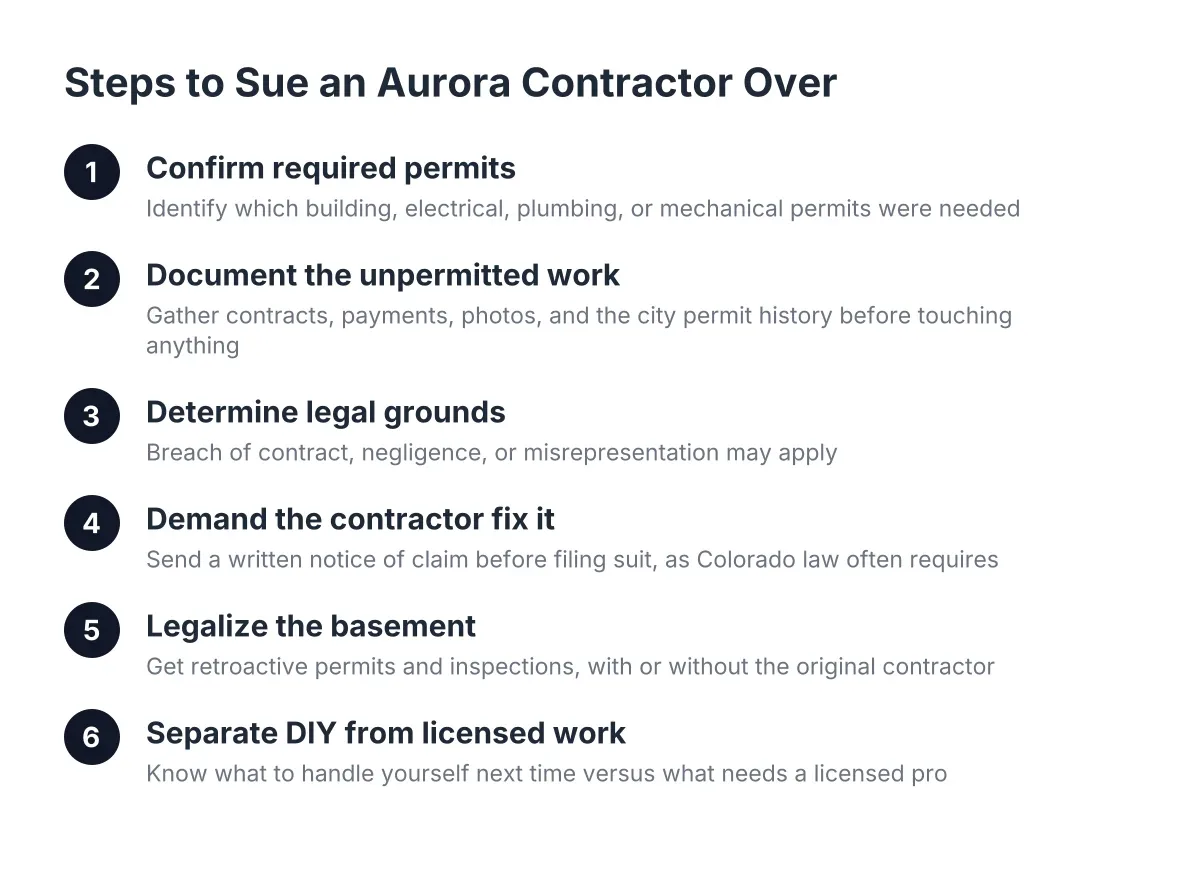
Step 1: Confirm Which Permits Your Basement Finish Required
Before you can hold anyone accountable, you need to know what was legally required. In Aurora, finishing a basement almost always requires a building permit, plus separate electrical, plumbing, and mechanical permits depending on the scope. If your project included any of the following, permits were required:
- New walls, framing, or drywall
- New electrical circuits, outlets, or lighting
- A bathroom, wet bar, or any new plumbing
- Ductwork changes or a new HVAC run
- An egress window cut into the foundation
- Adding a bedroom or any sleeping room
Egress windows deserve special attention. Cutting a concrete foundation wall for a basement escape window always triggers a permit and inspection. The code is specific here. Under the IRC 2024 code, every basement sleeping room needs an emergency escape opening with at least 5.7 square feet of net clear opening, according to EgressUSA. The opening also needs a maximum sill height of 44 inches above the finished floor and a minimum net clear width of 20 inches, according to The Great Egress Co. If your contractor added a "bedroom" downstairs with no compliant egress window, you have both a permit problem and a life-safety problem.
You can verify what permits were actually pulled by requesting the permit history for your address from the City of Aurora building division. That record is the foundation of everything that follows.
Step 2: Document the Unpermitted Work Before You Touch Anything
Next, build your paper trail. If you later sue, or even just negotiate, the homeowner with photos, contracts, and dates wins. Gather the following:
- Your signed contract and any change orders
- Every payment record, including checks, transfers, and receipts
- Photos of the finished work, plus any photos taken during construction
- Texts and emails where the contractor discussed permits or inspections
- The permit history report from the city showing what was and was not filed
Pay close attention to what the contract says about permits. Many contracts state the contractor will obtain all required permits. If yours does, the breach is clear. If the contract is silent, Colorado courts still generally expect a contractor to perform work in compliance with local building codes, which includes pulling required permits.
Do not open walls or start corrections yet. The condition of the work as the contractor left it is your evidence.
Step 3: Can You Sue a Contractor for Unpermitted Basement Work and What Legal Grounds Apply
So, can you sue an Aurora contractor over missing permits? Generally yes, and you usually have more than one legal theory available. Homeowners in this situation commonly pursue breach of contract, negligence, or violations of consumer protection law, depending on the facts. Which path fits depends on what the contractor promised and what the unpermitted work will cost to fix.
Here is how the options typically break down:
- Breach of contract: the contractor promised permitted, code-compliant work and did not deliver it. Damages are usually the cost to legalize or redo the work.
- Negligence: the work itself is defective or unsafe, such as a sleeping room with no compliant egress window.
- Misrepresentation: the contractor told you permits were pulled when they were not, or charged you a permit fee and pocketed it.
Small claims court in Colorado handles disputes up to a set dollar limit and does not require a lawyer. Larger claims, which is common when a full basement finish has to be opened up and re-inspected, go to county or district court. One honest caveat: this article is contractor perspective, not legal advice. Before you file anything, talk to a Colorado construction attorney, because deadlines called statutes of limitation can bar your claim if you wait too long.
Also check whether the contractor was licensed with the city. An unlicensed contractor working without permits strengthens your case, and the city may pursue its own penalties against them separately from anything you do.
Step 4: Demand the Contractor Fix It Before Going to Court
However strong your case looks, Colorado law generally requires you to give the contractor a chance to fix construction defects before you sue. This is often called a notice of claim or right-to-repair process. When you sue a contractor for unpermitted basement work, send a written demand, by certified mail, that spells out the unpermitted work and asks the contractor to obtain retroactive permits, open the work for inspection, and correct anything that fails.
For example, suppose a homeowner in southeast Aurora paid for a basement finish with a guest suite, then discovered during a pre-listing inspection that no permits were ever filed. In that scenario, the demand letter would ask the contractor to pull a retroactive permit, remove drywall where inspectors need to see wiring and framing, pass rough-in and final inspections, and restore the finishes, all at the contractor's expense.
Sometimes the contractor complies, because the alternative is a lawsuit plus a complaint to the city licensing office. If they refuse or disappear, your documented demand letter becomes a strong exhibit in court.
Step 5: Get the Basement Legalized, With or Without the Original Contractor
Whether or not your lawsuit succeeds, the basement still needs to become legal. Winning a judgment does not make the work permitted; only the City of Aurora inspection process does that. The retroactive permit route typically involves:
- Applying for a permit for the as-built work
- Opening sections of drywall so inspectors can see electrical, framing, and insulation
- Correcting anything that fails, which commonly includes wiring shortcuts and missing egress
- Passing rough-in and final inspections, then patching and refinishing
Expect electrical to get close scrutiny. Basement finishing projects normally require an electrical rough-in inspection and a later insulation inspection, and unpermitted jobs skipped both. Shortcuts like exposed non-metallic cable in locations where it does not belong are a frequent failure point; the National Electrical Code (NFPA 70) does not allow Romex run inside EMT in damp or wet locations, for example. This is where a licensed electrician earns their fee, and it is not a DIY correction.
The payoff is real. A properly permitted finished basement is a selling point, not a liability. A national basement remodel returns 71% of its cost at resale on average, according to the JLC (Journal of Light Construction) Cost vs. Value Report, but that value assumes the square footage counts as legal, finished space.
Step 6: Separate What You Can DIY From What Needs a Licensed Pro Next Time
Finally, use this experience to hire smarter. A clear line between homeowner work and licensed work is the best protection against repeating the problem. In Aurora, a homeowner can often pull their own permit and handle certain tasks on their own home, but the trades draw hard lines.
Reasonable DIY territory, with a homeowner permit and inspections:
- Framing walls and hanging drywall
- Insulation, paint, trim, and flooring
- Basic carpentry, where imperfect cosmetic results stay hidden anyway
Call a licensed pro for:
- All electrical circuits, panels, and new outlets
- Plumbing for a bathroom or wet bar
- HVAC and ductwork changes, including rerouting ducts around a low ceiling basement
- Egress window installation, since it requires cutting the concrete foundation
When you interview the next contractor, ask three questions. Who pulls the permits, you or me, and will I see the approved permit before work starts? Which inspections does this project require, and when do they happen? Will the quote itemize permit fees separately? A contractor who answers those in plain language is showing you how they work. One who waves off basement remodeling permits as unnecessary paperwork is showing you a future lawsuit.
When Suing Aurora Contractors Is Worth It, and When It Is Not
Suing an unpermitted contractor makes sense when the correction costs are large, the contractor is solvent, and your documentation is solid. It makes less sense when the fix is cheap, the contractor has no assets, or you need the basement legalized fast for a sale. In that last case, paying to legalize the work yourself and pursuing the contractor afterward is often the practical order of operations.
Weigh the trade-off honestly. Litigation takes months or years; a retroactive permit and corrections can often finish faster. If you are selling within a year, speed may matter more than the principle. If the defects are serious, such as a bedroom with no basement escape window, fix the safety issue first regardless of what happens in court.
If you are in Aurora and staring at a basement you suspect was finished without permits, start with Step 1 today: pull the permit history for your address. From there, a local basement finishing contractor who handles permit assistance can walk the space with you, explain what inspectors will want opened up, and give you a free estimate for legalizing the work. That one conversation usually tells you whether this is a repair bill or a court case.
If you need basement finishing, Aurora Basement Finishing Pros can help.
Prefer to talk it through? Call (720) 973-5727 — a quick call is usually the fastest way to get a straight answer for your situation.